Skiing Speed Wing Guide
Deploy, dive, swoop, and loop across Vire Peak without throwing away your run.
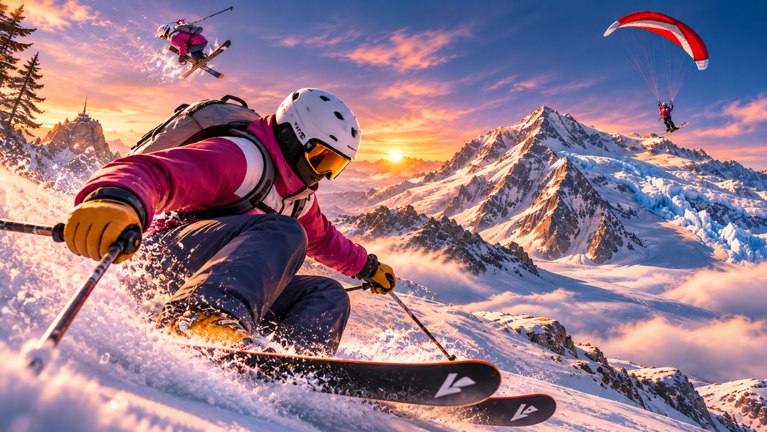
What the speed wing does
The speed wing is Skiing’s airborne travel and style tool. On a mountain the size of Vire Peak—4,100 m summit, 2,850 m of vertical to the valley—you will sometimes want to cover empty air, bail a bad jump trajectory, or link distant trail pods without waiting on a gondola. The wing is that answer. It is not a replacement for carving, racing, or learning edges on snow.
If you still need spawn and equipment basics, read Getting Started and Controls first.
How to activate
Hold jump while you are in the air. That is the official deploy rule. A tap jumps; a hold in freefall or after a pop opens the wing so you can dive, swoop, and loop.
Activation checklist:
- Leave the snow with a deliberate pop or from a drop zone / jump lip.
- Confirm you have open air ahead—not an immediate tree wall.
- Hold jump to deploy.
- Steer into a dive or swoop; add loops only when you still have altitude to spare.
- Recenter for landing, then return to skis or snowboard control on snow.
If the wing keeps opening when you did not want it, you are holding jump on every little air. Retrain yourself: short taps for park pops, intentional holds for glide.
Dive, swoop, and loop — what each is for
Dive
Diving trades altitude for speed and a steeper approach. Use it when you deployed too high above a trail and need to rejoin the fall-line quickly. Dive early enough that you can still flare or swoop before the snow; diving straight into a knuckle is just a fancy crash.
Swoop
Swooping is the horizontal tool—carry across a gully, skip a flat, or arrive at a park feature with style. Think of it as drawing a smooth curve toward your landing zone. Keep the camera on the target snow, not on the sky.
Loop
Loops are style and altitude burners. They look great on open faces and above wide landings. They are a poor choice inside couloirs, dense forest, or low over a rail garden. If you cannot see a safe recovery after the loop, do not start it.
When to wing vs when to ski
Prefer skiing or snowboarding when:
- You are on a timed race line chasing medals or ghosts (Races and Records).
- You are grinding rails, boxes, or wall rides (Tricks).
- You are learning a new groomer and need snow feedback.
- You are inside a narrow couloir where glide path options are zero.
Prefer the speed wing when:
- You overshot a jump and need a controllable descent to safe snow.
- You want to cross open air between trail networks faster than hiking or waiting.
- You are sightseeing a new aspect of the LiDAR terrain from above before committing.
- You are linking Backside Park exits toward another pod and have clear sky.
Gondolas still win for pure uplift. The wing does not replace the nine gondolas or map drop-in—it complements them. Travel planning belongs with Trails and Map.
Combining wing with freestyle
Advanced lines sometimes pop a jump, throw a trick, then hold jump to wing out if the landing went wrong—or swoop into a distant feature. Keep priorities straight:
- Survive the trick landing if you are still over the intended snow.
- Only deploy mid-mistake when the alternative is a guaranteed cartwheel into hazards.
- Do not open the wing during a grind; you need board or ski contact.
The Trick Book’s 1,400+ moves stay on snow and jump features. The wing is its own movement layer.
Safety habits on a real-scale mountain
Because the mesh comes from real survey data, cliffs and tree bands are not theatrical props. Before deploying:
- Check altitude above the valley floor mentally—you have a lot of air to play with from high shelves, almost none from low forest exits.
- Avoid deploying toward Shadow Shelf helicopter traffic patterns if the area is crowded; give other riders space in 20-player servers.
- Never assume THE WEST’s 5,065 m pass terrain forgives the same mistakes; higher massifs mean longer falls if you misjudge a dive.
Practice drill (10 minutes)
- Map drop or gondola to a wide open face above a groomer.
- Straight air off a small rollover; hold jump to deploy; swoop to the groomer; ski out clean (5 reps).
- Same setup with a dive to a lower bench (3 reps).
- One loop only if the previous reps landed softly (2 reps max).
- Finish with a no-wing ski run so you do not forget edges.
Friend sessions and XP
Riding with friends still grants +10% XP whether you are carving or winging between meet-up points. Use the wing to regroup on a big mountain without forcing everyone to wipe and reset. Clubs with emblems help you spot your group after a long swoop.
Related guides
- Guides Hub — all tutorials
- Controls — jump hold vs tap discipline
- Trails and Map — where open air corridors exist
- Tricks — keep freestyle separate from panic glides
- Races and Records — when to leave the wing packed
Master deploy timing first. Fancy loops are optional; controllable swoops are what make the speed wing feel like part of Skiing instead of a random parachute.
Frequently Asked Questions
Quick answers for Skiing on Roblox.
How do you open the speed wing in Skiing?
Hold jump while you are in the air. Then dive, swoop, or loop toward a safe landing.
Should I use the speed wing on race lines?
Usually no. Timed races reward clean ski or snowboard lines. Save the wing for travel, recovery, or open-face style.
Why does my speed wing open by accident?
You are holding jump on small airs. Tap jump for pops and only hold when you intend to glide.
Is the speed wing a replacement for gondolas?
No. Nine gondolas and map drop-in handle uplift and teleports. The wing helps with airborne travel and mid-air recovery.