Skiing Trick Book and Freestyle Guide
1,400+ tricks on Vire Peak—learn spins, grabs, and grinds without wasting every landing.
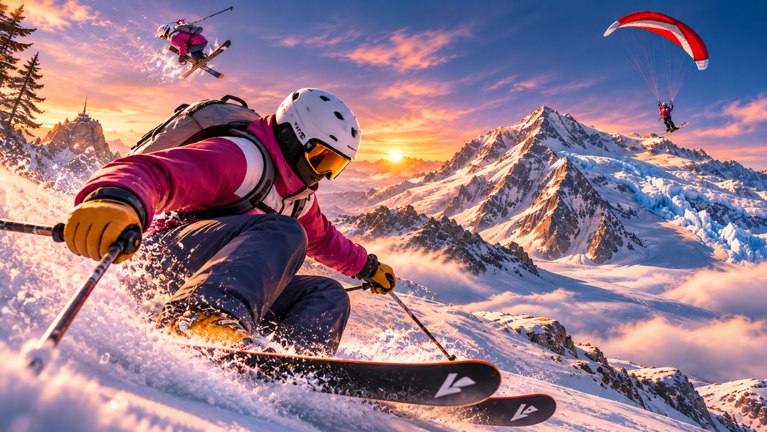
What the Trick Book is for
Skiing ships with a Trick Book of 1,400+ moves: spins through 1440, corks, rodeos, flips, grabs, and grinds. That library is deep on purpose. You are not meant to unlock swagger in one evening on a single roller. This guide teaches a practice loop that works on Vire Peak’s real LiDAR terrain—especially the 17 big jumps on three trails, the 46 rails and boxes, the 5 wall rides, and the 2.7 km Backside Park stunt course.
New to the mountain? Skim Getting Started and Controls first so jump and camera inputs are stable. For “what feels strong right now,” pair this page with the Tier List.
Feature map for freestyle
Know where to train before you invent a line:
- Big jumps (17 on three trails) — Best for spins, flips, corks, and grab combinations with real airtime.
- Rails and boxes (46) — Grinds, boardslides, and balance drills. Approach straight, commit, and dismount to a clear out-run.
- Wall rides (5) — Transfer tricks and style points; keep speed honest so you do not stall halfway up the wall.
- Drop zones (19) — Natural air where you practice spotting the landing more than spinning for score.
- Backside Park — Banked turns plus a race: the best place to chain style into speed without leaving the stunt environment.
Trail locations and how to reach them with gondolas or map drop-in are covered in Trails and Map.
Practice order that actually sticks
1. Straight airs and axis control
Before any spin, pop a jump and land facing downhill with skis or board quiet. If you cannot do that five times in a row, spins will only amplify the crash. Use a medium jump table, not the biggest kicker on the mountain.
2. Simple grabs
Add one grab in the middle of the air, then release before the landing. Grabs teach timing without forcing rotation. On snowboard and skis the silhouette differs, but the rule is identical: grab after you leave the lip, release before the snow.
3. 180 and 360 spins
Start with 180s so you learn to ride away switch or re-square. Move to 360s only when you can spot the landing halfway through the spin. Climb the ladder toward bigger numbers—including the book’s path up to 1440—only when smaller spins are boringly clean.
4. Flips, corks, and rodeos
Off-axis moves (corks, rodeos) punish late inputs harder than flat spins. Take them on jumps with long, visible landings. If the knuckle is blind, you are practicing luck, not freestyle.
5. Grinds
On rails and boxes, prioritize entry speed and alignment. Too slow and you stall; too sideways and you clip the end. Grind a short box end-to-end before you chase long down-rails or transfer lines onto wall rides.
Chaining without greed
Chaining means linking compatible tricks across one feature or a short park sequence. Good chains look like:
- Clean pop
- Spin or flip with a grab
- Spot landing
- Soft carve into the next feature
- Grind or second air only if speed remains honest
Bad chains look like spinning on every roller until a cartwheel deletes the run. Backside Park’s banked turns exist so you can carry speed between features—use them as connectors, not as extra crash opportunities.
When you add the speed wing mid-line, remember it is a travel tool: hold jump in the air, then dive or swoop. Do not open the wing in the middle of a grind setup. See Speed Wing.
Landing tips that save runs
- Eyes on the snow early. If you only watch your avatar’s rotation, you will miss the landing pitch.
- Finish rotation before the snow. Under-rotated landings sideways are the number-one wipeout.
- Match the landing slope. Absorb with the fall-line; fighting a steep landing upright throws you forward.
- Bail with intent. If the trick is lost mid-air, stop adding inputs and prepare a flat recovery instead of forcing a 900.
- Recenter the camera after big airs so the next feature is readable.
Skis vs snowboard for style
Both are valid. Skis can feel precise for switch landings and race-adjacent freestyle into timed lines. Snowboards often feel natural for presses, butters into boxes, and park flow in Backside Park. Swap only when stopped—see Controls—and relearn one trick family after each swap so you do not blame the mountain for equipment confusion.
Tying tricks to races and progression
Freestyle and racing share the same mountain. Clean airs that keep speed help medal runs; messy showboating costs time. When you hunt medals, ghosts, and spot records, decide per run whether the goal is style or clock—see Races and Records. Riding with friends still grants +10% XP, which helps long Trick Book grinding sessions.
Use the Tier List when you want a curated “practice these first” shortlist instead of staring at 1,400 entries. The book is a catalog; the tier list is a filter.
Sample 20-minute drill block
- 5 min — Straight airs on a medium jump; five clean landings.
- 5 min — Same jump with one grab, then 180s.
- 5 min — Short box grinds end-to-end.
- 5 min — Backside Park lap chaining one air into one grind without wiping.
Repeat tomorrow with 360s or a cork only if yesterday’s block was clean.
Related reading
- Guides Hub — full tutorial index
- Trails and Map — where jumps, couloirs, and park sit
- Tier List — prioritize strong tricks and lines
- Updates — patch changes that affect feel or scoring
Master a few moves deeply. The Trick Book will still be there when you are ready for the absurd spin counts.
Frequently Asked Questions
Quick answers for Skiing on Roblox.
How many tricks are in the Skiing Trick Book?
Over 1,400, including spins up to 1440, corks, rodeos, flips, grabs, and grinds. Practice a short list before browsing the whole catalog.
Where should I practice freestyle first?
Use the three trails with 17 big jumps for airs, the 46 rails and boxes for grinds, and Backside Park for linked stunt laps.
How do I chain tricks safely?
Land clean, keep speed, and only add the next trick when the landing or rail entry is visible. Bail early if a rotation is lost.
Should I follow the tier list for tricks?
Yes for prioritization. This guide teaches how to practice; the Tier List helps you choose which moves and lines matter most right now.